






Dental implants can’t develop cavities like natural teeth, but that doesn’t mean they don’t require regular cleaning and professional maintenance.
In fact, one of the biggest misconceptions about dental implants is that once treatment is complete, the implants are essentially maintenance-free.
They aren’t.
Plaque and bacteria can accumulate around dental implants just as they can around natural teeth. Without proper home care and professional maintenance, the gums and bone supporting an implant can develop inflammation and disease.
At Pearl Dental Group in Baton Rouge, we want patients to understand that long-term implant care begins as soon as treatment is completed.
The way you clean your implants depends heavily on whether you have one implant crown, an implant-supported bridge, a removable implant denture, or a fixed full-arch implant restoration.
Why Do Dental Implants Need to Be Cleaned?
A dental implant is typically made from titanium or a titanium alloy, so the implant itself cannot develop tooth decay.
However, the tissues surrounding it are still biological.
Plaque can accumulate where the implant restoration meets the gum tissue. If it isn’t adequately removed, the surrounding tissues can become inflamed.
This makes daily plaque removal an important part of protecting your implant investment.
What Happens If You Don’t Clean Dental Implants?
Poor implant hygiene can contribute to inflammation around an implant.
Two conditions patients should understand are:
Peri-Implant Mucositis
Peri-implant mucositis involves inflammation of the soft tissues surrounding an implant without the progressive supporting bone loss associated with peri-implantitis.
Signs may include:
- Redness
- Swelling
- Bleeding
- Tenderness
Identifying inflammation early is important.
Peri-Implantitis
Peri-implantitis is an inflammatory condition involving the tissues surrounding an implant and is associated with progressive loss of supporting bone.
Possible signs can include:
- Bleeding around the implant
- Swollen gums
- Drainage
- Gum recession
- Deepening pockets
- Bone loss
- Implant exposure
- Implant mobility in advanced cases
If you notice changes around an implant, don’t wait until your next routine appointment to mention them.
How Do You Clean a Single Dental Implant?
A single implant crown can often be cared for similarly to a natural tooth.
Daily care typically focuses on cleaning the crown and removing plaque where the restoration meets the gum tissue.
Depending on your individual situation, your dental team may recommend:
- A soft toothbrush or electric toothbrush
- Dental floss
- Interdental brushes
- Water flossing
- Other specialized cleaning aids
The most important area isn’t necessarily the middle of the implant crown.
It’s the area around the gumline, where plaque and bacteria can accumulate.
Can You Floss Around Dental Implants?
Yes, but technique matters.
Floss can be useful around many implant restorations, but the design of the restoration determines the best approach.
A single implant crown is different from an implant bridge or fixed full-arch prosthesis.
Your hygienist or dentist should demonstrate exactly how to clean around your particular restoration rather than simply telling you to “floss your implants.”
Should You Use an Electric Toothbrush With Dental Implants?
For many patients, an electric toothbrush can be an effective tool for plaque removal around implant restorations.
The important issue isn’t whether the toothbrush is manual or electric.
It’s whether you’re consistently and effectively removing plaque without traumatizing the surrounding tissues.
Your dental team can recommend an appropriate brushing technique based on your restoration and gum health.
Can You Use a Water Flosser Around Dental Implants?
Water flossers can be helpful for many implant patients, particularly when cleaning areas that are difficult to reach with conventional floss.
They can be especially useful around:
- Implant-supported bridges
- Implant-supported dentures
- Fixed full-arch restorations
- Areas underneath prosthetic teeth
However, a water flosser shouldn’t automatically be considered a replacement for every other form of cleaning.
Depending on the restoration, the best home-care routine may involve a combination of brushing, water flossing, interdental cleaning, and other techniques.
How Do You Clean an Implant-Supported Bridge?
Implant-supported bridges require cleaning underneath the replacement teeth.
Because the restoration is connected, conventional floss cannot simply pass down between each tooth from the chewing surface.
Patients may need:
- Floss threaders
- Specialized implant floss
- Interdental brushes
- Water flossers
- Other recommended cleaning aids
Food and plaque can accumulate underneath the bridge, so cleaning only the visible surfaces isn’t enough.
How Do You Clean Implant-Supported Dentures?
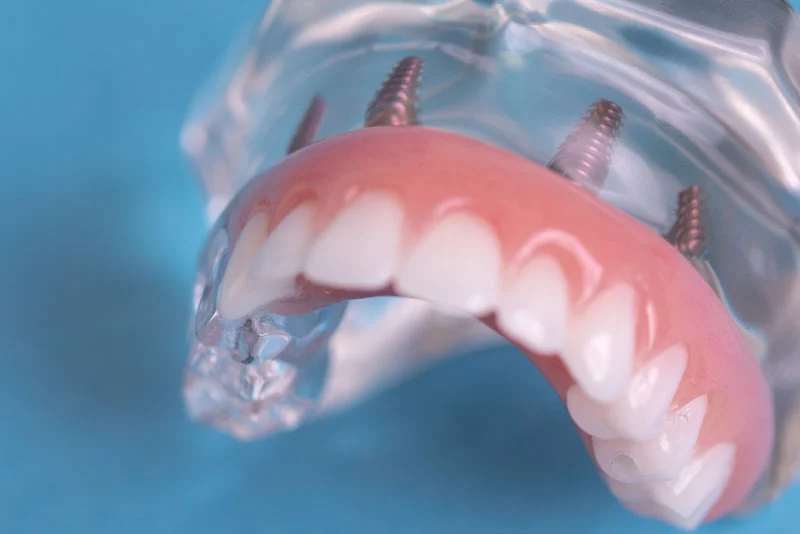
An implant-supported removable denture requires care of both the denture and the implant components in the mouth.
Because the prosthesis can be removed, patients can clean the underside of the denture directly.
The implants or attachments inside the mouth also need careful cleaning.
Your dental team should provide instructions for cleaning:
- The removable prosthesis
- Implant attachments
- Gum tissue
- Areas surrounding the implants
The attachment components may also wear over time and require periodic maintenance or replacement.
How Do You Clean All-on-4 or All-on-X Dental Implants?
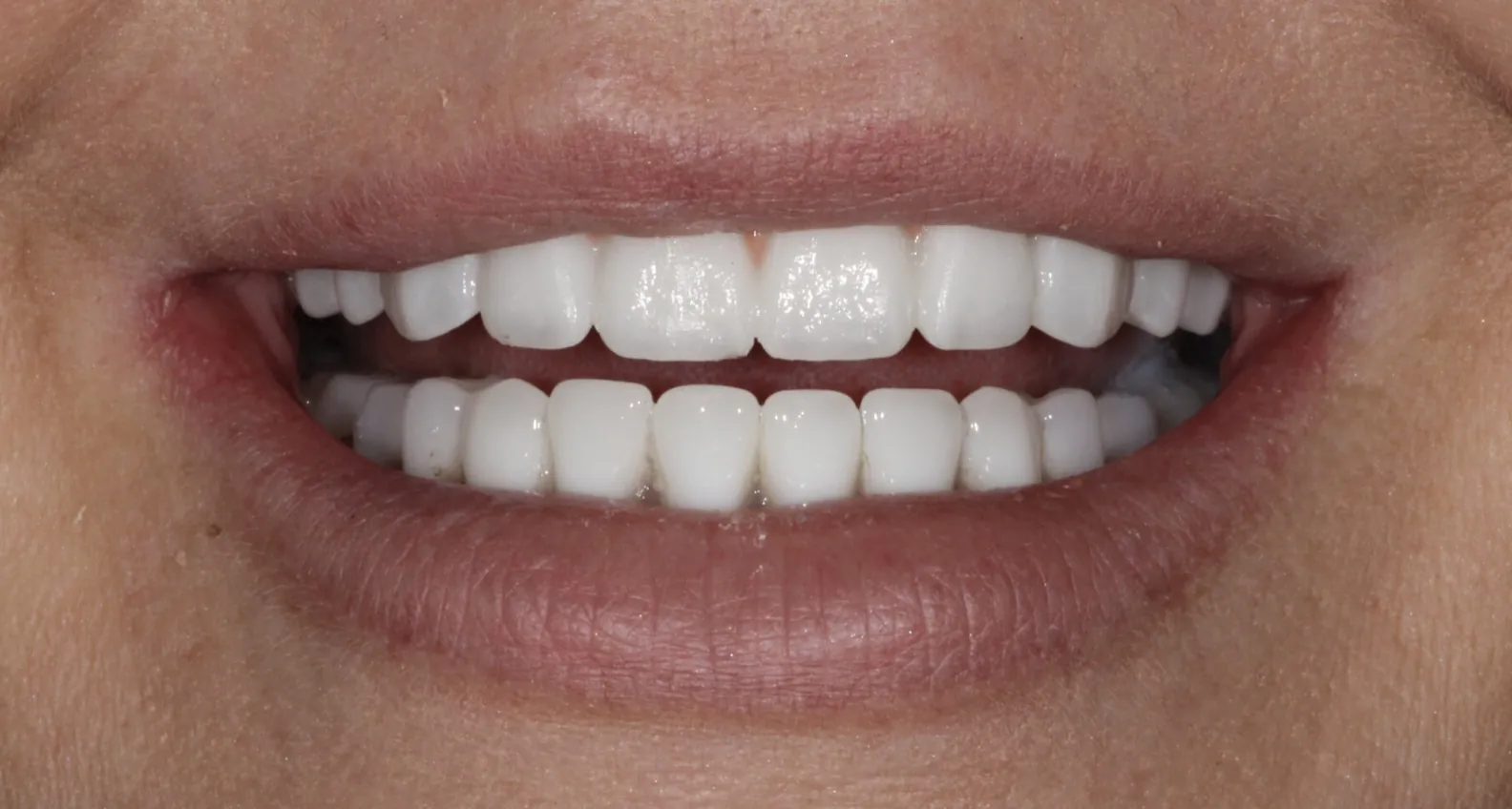
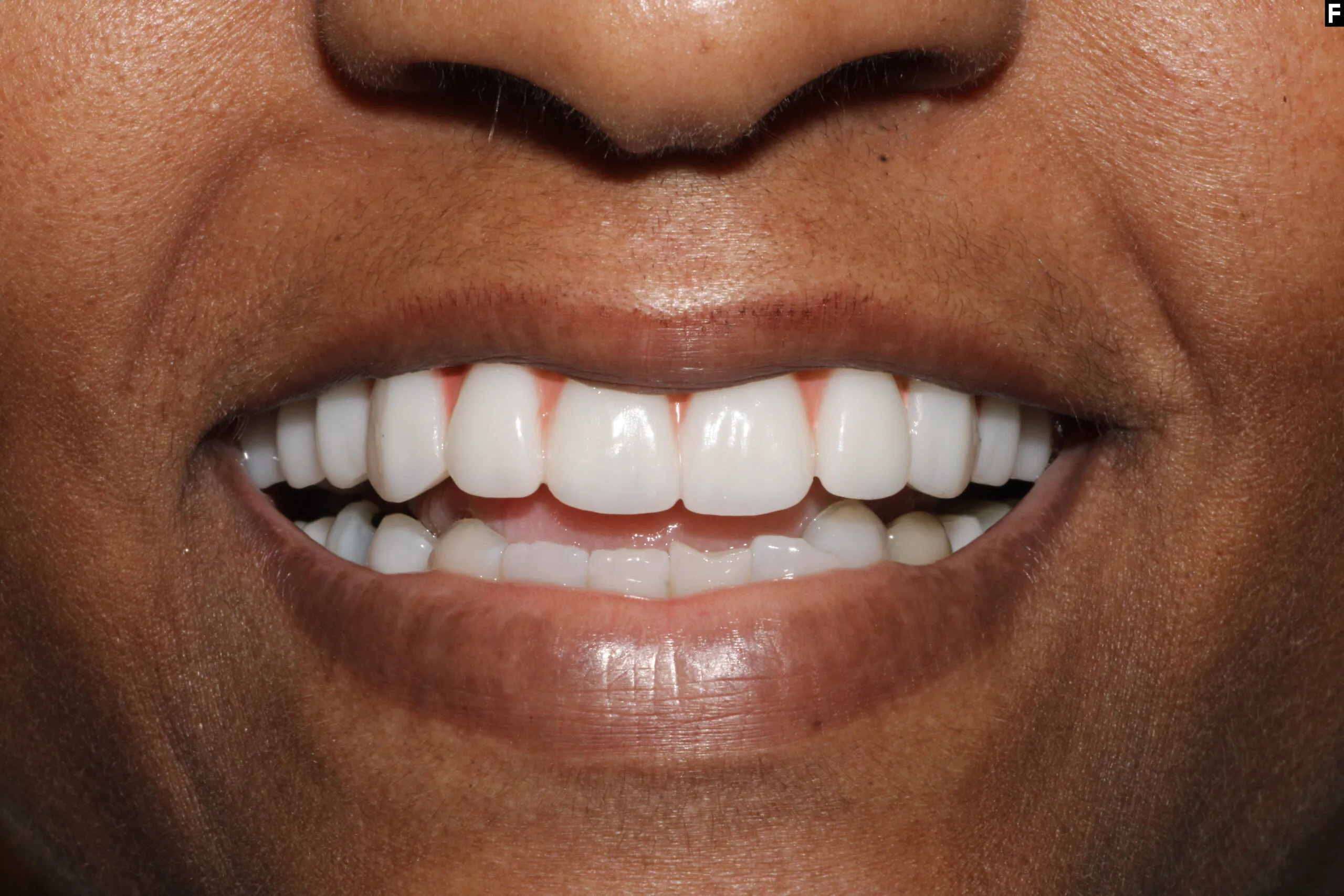
Cleaning a fixed All-on-4 or All-on-X restoration is meaningfully different from cleaning natural teeth.
This is extremely important for patients considering full-mouth implant treatment.
A fixed full-arch prosthesis remains attached to the implants, but there is space underneath portions of the restoration where plaque and food can accumulate.
Patients need to clean under the bridge, not simply brush the visible teeth.
Depending on the design of the restoration, useful tools may include:
- Water flossers
- Floss threaders
- Specialized floss
- Interdental brushes
- End-tuft brushes
- Other implant-specific cleaning aids
Your dental team should demonstrate the technique appropriate for your particular prosthesis.
Can Food Get Under Full-Mouth Dental Implants?
Yes.
A fixed full-arch restoration does not emerge from the gums exactly like a complete set of natural teeth.
There is a transition between the prosthesis and the patient’s tissues.
Food particles and plaque can accumulate in this area.
This doesn’t necessarily mean something is wrong with the restoration, but it does mean that daily cleaning underneath the prosthesis is essential.
If you consistently have difficulty cleaning underneath your restoration or food is becoming trapped in a particular area, let your dental team know.
Sometimes the hygiene technique needs to be modified, and in other situations the restoration itself may need to be evaluated.
How Often Should Dental Implants Be Professionally Cleaned?
There isn’t one maintenance interval that’s right for every implant patient.
The appropriate schedule depends on factors such as:
- Type of implant restoration
- History of periodontal disease
- Oral hygiene
- Smoking
- Medical history
- Amount of plaque or calculus
- Previous implant complications
- Number and location of implants
Some patients may be appropriate for routine intervals, while others benefit from more frequent professional maintenance.
Your dental team should establish a recall schedule based on your individual risk factors.
Is an Implant Cleaning Different From a Regular Dental Cleaning?
It can be.
Dental implants and implant restorations have different surfaces and components than natural teeth.
The dental professional performing maintenance needs to evaluate:
- Gum health
- Plaque accumulation
- Bleeding
- Pocket depths when appropriate
- Implant stability
- Restoration stability
- Bite
- Prosthetic components
- Bone levels when indicated
Specialized instruments or techniques may be used around implant restorations depending on the clinical situation.
Implant maintenance should involve more than simply polishing the visible prosthetic teeth.
Do Full-Mouth Dental Implants Need Professional Maintenance?
Absolutely.
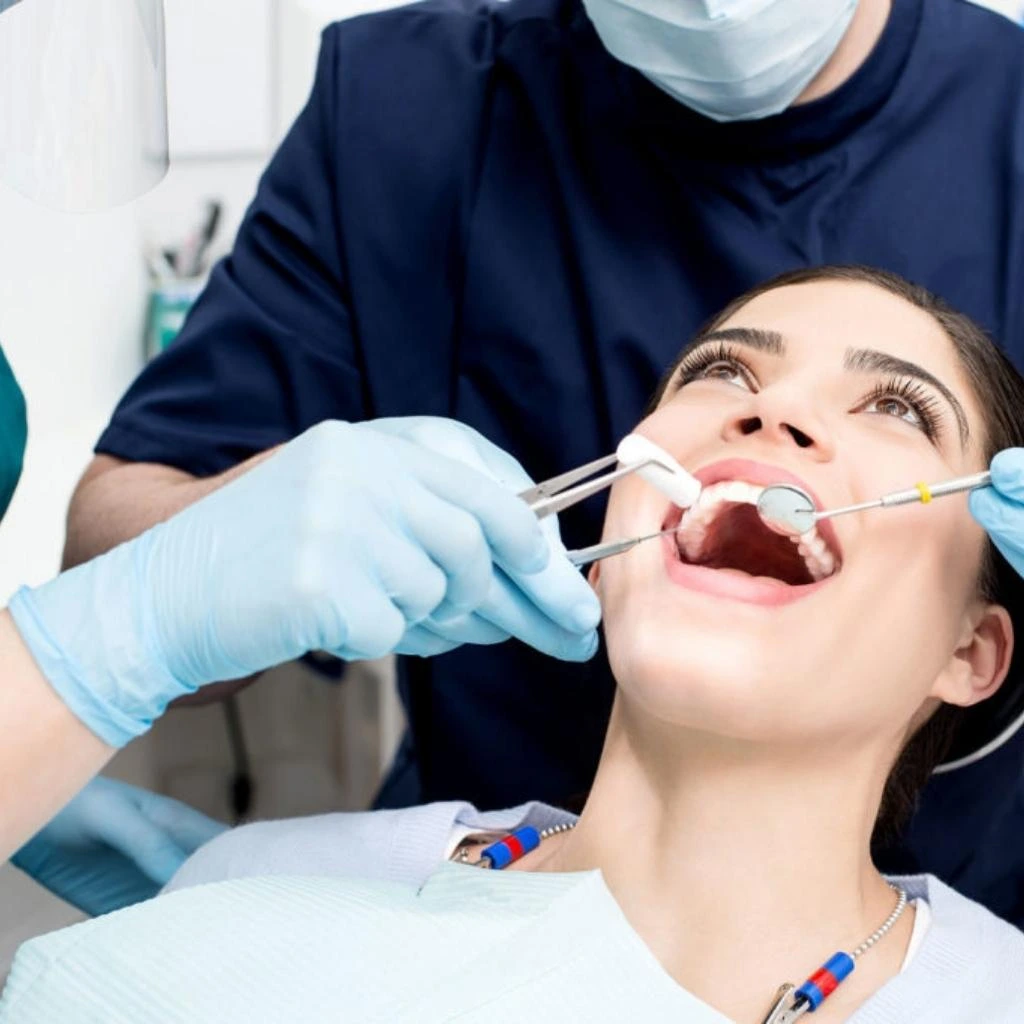
Patients with full-mouth dental implants should expect ongoing professional maintenance.
Even though the teeth are artificial, the gums and bone supporting the implants are not.
At maintenance appointments, the dental team can evaluate the health of the tissues, implant stability, prosthesis, bite, hygiene, and other factors.
Fixed implant teeth should be viewed as a long-term restoration that requires ongoing care—not as a treatment that eliminates the need to visit the dentist.
Does a Full-Arch Implant Bridge Need to Be Removed for Cleaning?
Not necessarily at every maintenance visit.
Whether a fixed full-arch prosthesis should be removed professionally depends on the restoration, clinical findings, hygiene access, implant components, and the treating dentist’s maintenance protocol.
Routine removal of a fixed prosthesis simply because a certain amount of time has passed isn’t necessarily appropriate for every patient.
Your dentist should determine whether removal is indicated based on your individual situation.
Can Dental Implants Develop Tartar?
Yes.
While the implant itself cannot decay, plaque can mineralize into calculus around implant restorations.
Once hardened deposits develop, they generally require professional removal.
This is another reason regular maintenance remains important even for patients who feel that they’re doing an excellent job cleaning at home.
Should Dental Implant Patients Still Get X-Rays?
Dental imaging may periodically be recommended to evaluate the bone surrounding implants and other structures that can’t be fully assessed by visual examination alone.
The type and frequency of imaging depend on the patient’s individual situation.
Dental X-rays can help the dentist monitor bone levels and compare changes over time when clinically indicated.
What Are Signs That an Implant Needs Professional Attention?
Contact your dentist if you notice:
- Bleeding around an implant
- Persistent swelling
- Drainage
- Persistent bad taste
- Gum recession
- Food trapping that suddenly becomes worse
- Pain when chewing
- A change in your bite
- A loose crown or bridge
- Chipping or fracture
- Movement of the implant or restoration
A loose implant restoration does not necessarily mean the implant itself has failed.
However, continuing to chew on a loose restoration can potentially cause additional problems.
Have it evaluated.
Does Smoking Make Implant Maintenance More Important?
Smoking and nicotine use are important risk factors in implant dentistry.
Smoking can affect healing and is associated with increased risk of problems involving the tissues surrounding implants.
Patients who smoke should discuss their tobacco and nicotine use honestly with their dental team.
Excellent home care and professional maintenance are particularly important for patients with additional risk factors.
Can Teeth Grinding Affect Dental Implants?
Yes.
Clenching and grinding can place significant forces on implants and their restorations.
These forces can contribute to mechanical complications such as:
- Screw loosening
- Chipping
- Restoration fracture
- Excessive wear
If you grind or clench your teeth, your dentist may recommend additional evaluation or a protective appliance depending on your situation.
Are Dental Implants Maintenance-Free?
No.
This is worth repeating because it’s one of the most important things patients should understand before choosing implant treatment.
Dental implants are not maintenance-free teeth.
The implants, gums, bone, prosthetic components, bite, and restoration all need to be monitored.
A fixed full-mouth restoration may not develop cavities, but that doesn’t eliminate the possibility of:
- Gum inflammation
- Peri-implant disease
- Bone loss
- Screw loosening
- Chipping
- Wear
- Fracture
- Hygiene problems
Long-term maintenance is part of implant treatment.
How Long Do Dental Implants Last With Proper Care?
Dental implants can provide long-term tooth replacement, but no responsible provider should promise that every implant or restoration will last for life.
Longevity depends on numerous factors, including:
- Implant health
- Bone and gum health
- Oral hygiene
- Smoking
- Medical health
- Bite forces
- Restoration design
- Professional maintenance
- Patient compliance
The implant fixture and the prosthetic restoration attached to it should also be considered separately.
Even when an implant remains healthy, a crown, bridge, attachment, or full-arch restoration may eventually require maintenance, repair, or replacement.
How Pearl Dental Group Approaches Implant Maintenance
At Pearl Dental Group in Baton Rouge, we believe implant maintenance should be considered part of treatment from the beginning.
When planning implant restorations, we consider not only how the teeth will look and function, but also how the patient will clean them.
This becomes especially important with complex full-arch restorations.
Patients need to understand:
- How to brush the restoration
- How to clean underneath it
- Which hygiene tools to use
- How frequently to return for professional maintenance
- Which warning signs should be reported
- What long-term prosthetic maintenance may be necessary
The goal isn’t simply to place implants successfully.
The goal is to help patients maintain healthy implants and functional restorations for as long as possible.
Protecting Your Investment in Dental Implants
Dental implants can represent a significant investment in your health, appearance, and ability to eat comfortably.
Protecting that investment requires a partnership between the patient and dental team.
Daily home care + professional implant maintenance + early identification of problems provide the best approach to long-term implant care.
If you’ve already invested in implants, don’t wait until something hurts to have them evaluated.
Many implant problems are easier to address when they’re identified early.
Need Dental Implant Maintenance in Baton Rouge?
Whether you have one implant crown, several implants, an implant-supported denture, or a fixed full-mouth restoration, regular maintenance is an important part of protecting your treatment.
At Pearl Dental Group in Baton Rouge, we provide dental implant treatment as well as ongoing evaluation and maintenance of implant restorations.
If you have questions about cleaning your implants, are having difficulty getting underneath a full-arch restoration, or haven’t had your implants professionally evaluated recently, we can help determine an appropriate maintenance plan.
Schedule an appointment with Pearl Dental Group for a dental implant evaluation or maintenance visit.
If you’re still considering implant treatment, learn more about our dental implant options in Baton Rouge, including single implants, implant-supported restorations, and full-mouth treatment.
This article provides general educational information and is not a substitute for individualized dental or medical advice. Implant hygiene techniques and professional maintenance recommendations should be customized to the patient’s restoration and clinical condition.